
From Core to Radical Value: Navigating Change with the 3-Step Value Model
Future-proofing looks different for every business, but this doesn’t mean that you have to start from scratch to build your strategy.
The 3-step value model, developed by our very own experts Daniel Rukare and Liliana Caimacan, is a structured framework designed to help businesses and business owners to understand the fundamentals of business transformation through evaluating their different portfolios.
This model enables businesses to respond proactively to deliver business transformation through 2 key objectives:
Transforming businesses to build sustainable growth through future-proofing
Develop the ability to define business growth paths and use OKRs (Objective & key Results), leading to the systemisation of innovations.
The model looks at two fundamental variables: value and performance, which are explored through an incremental 3-step process.
Step 1: Optimising Core Value
This step focuses on building efficiencies and optimising the core portfolios within the business. The most fundamental part of this step is the identification of your core portfolios. This is essential for understanding your business - don’t just look at portfolios contributing the largest revenue or margins, but also look at pillars like brand identity and brand equity. What processes can you implement to maximise the efficiencies within these portfolios?
Step 2: Creating Incremental Value
The next question is: how do we design resilient and transitional strategies? The make-or-break for this step is what your transition looks like from step one - is it proactive or reactive? Note that reactive strategies are fundamentally weak, since you’re either reacting to competitive pressure or downturns in your business. To take charge of this transition, you need to be proactive - take measures to anticipate changes in the market and capitalise on these shifts to maintain a competitive advantage.
Step 3: Capitalising on Radical Value
This brings us to the third step: being able to capitalise on radical value. Radical value sits in building and establishing what we refer to as ‘anti-fragility’ into future value opportunities. These opportunities might not be clearly defined at the time in which you will be making these decisions. These opportunities in the unknown - otherwise known as “strategic ambiguity areas” - are driven by disruption through innovation.
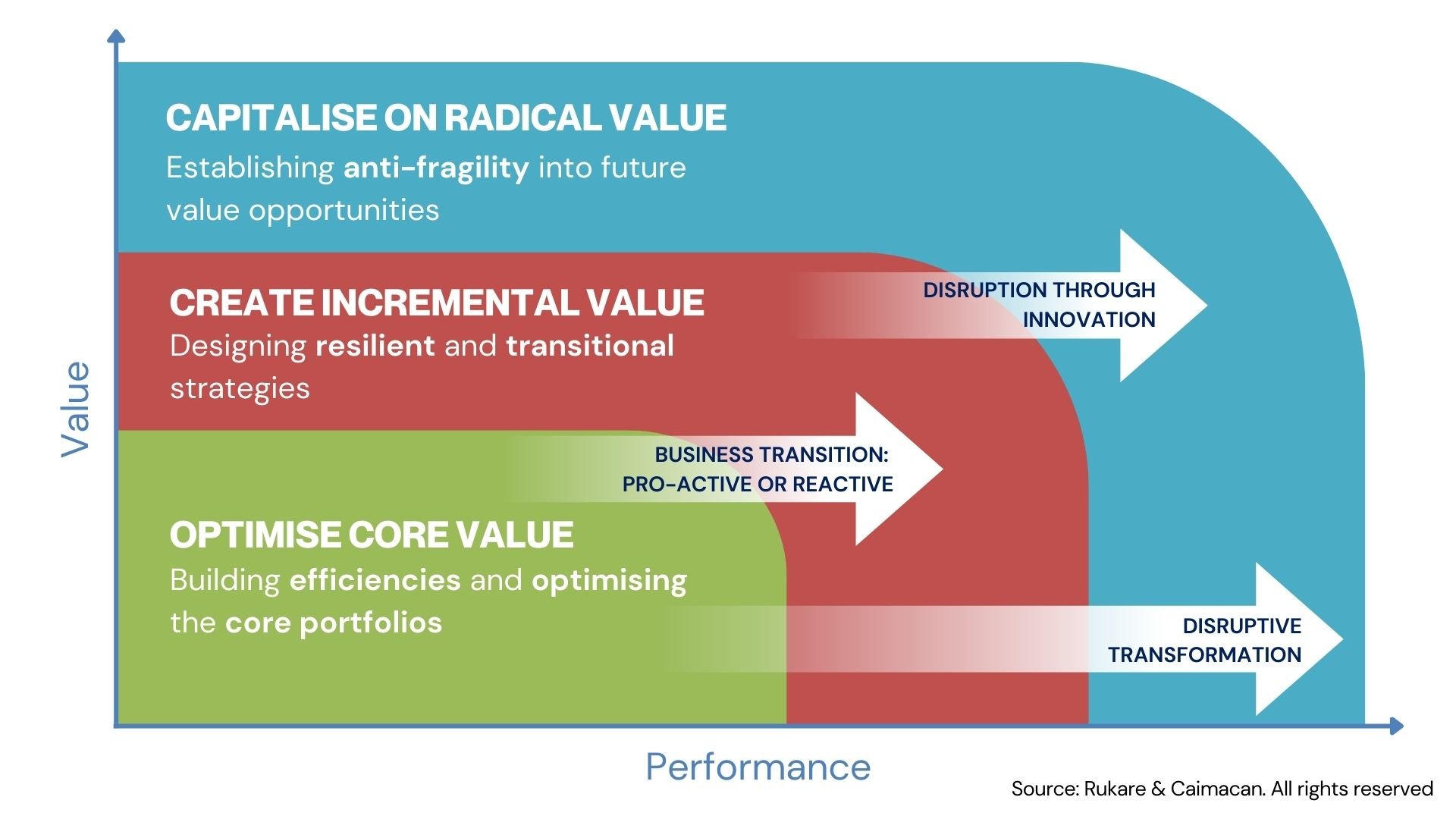
Despite these steps, there are instances in which companies transition from optimising core value all the way to capitalizing on radical value. These transitions - referred to as “disruptive transformation” - are mostly driven by advances in technology.
To navigate these shifts, businesses need a model that adapts. This model is built to be versatile across different businesses. The key is to apply these core questions to your business and ask yourself: where are you playing now and what must change to build resilience and stay ahead?
By taking a structured approach, you can turn ambiguity into opportunity, positioning your business for sustainable growth.
Need guidance through this process? Reach out to us and we can walk you through what this looks like for you.
